
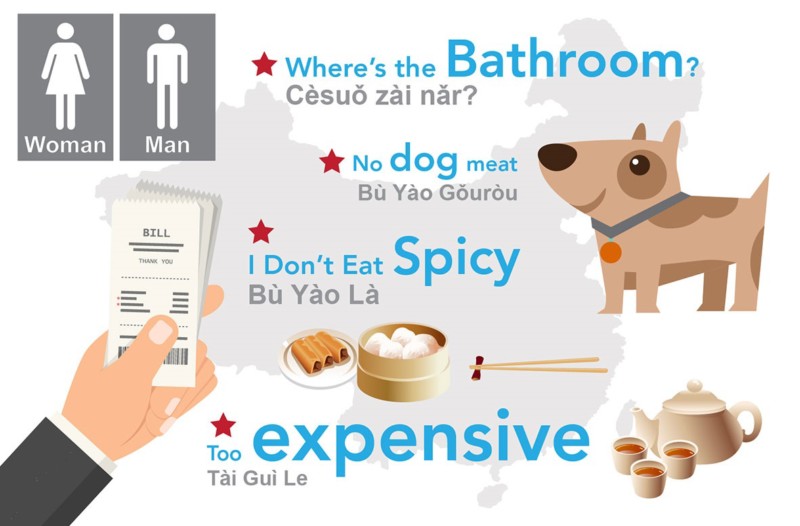
Mastery of the Chinese language takes a long time and most foreigners in China never learn it, but we want to equip you with simple but useful Chinese phrases. We know these phrases will come in handy at restaurants, local markets and as you explore China. Also, any effort you make at speaking Chinese will show respect for the culture and will help you make friends and be a good ambassador of your country. Plus, learning some Chinese will make you a better English teacher. Make the effort!
Any effort you make at speaking Chinese will show respect for the culture and will help you make friends and be a good ambassador of your country.
“Where’s the Bathroom?” (“Cèsuǒ zài nǎr? “)
There’s no denying that this phrase is high on the list of the most useful phrases. You never know when Mother Nature will call you, so you just have to be prepared. The simplest way to say this is “cèsuǒ zài nǎr?” — cèsuǒmeans “bathroom,” zài nǎr means “where.” Just be aware though, most foreigners say that going to Chinese bathrooms is far from being their most pleasant experience. We suggest that you answer the call of nature before you head out the door, and take advantage of somewhat decent restrooms found in shopping malls when possible. Otherwise, the squat toilets and doorless St. Johns found on the street may leave you speechless, to say the least.
“I Don’t Eat Spicy” ( “Bù Yào Là” )
Some delicacies such as málà xiāng guō (麻辣香锅 or hot and spicy fragrant pot”), kǎo yú (烤鱼 or grilled fish), and hot pot taste best when they are hot. We encourage you to try them so you can experience the whole Chinese dining experience, but if you absolutely hate feeling that burning sensation in your mouth, you can say “bù yào là”—“ bù yào” means “don’t want” and “là” means “spicy.”
“Too expensive” ( “Tài Guì Le” )
Your trip to Beijing won’t feel complete until you’ve done some good amount of shopping. In local markets though, all the products are often marked up more than five times the regular retail prices, therefore bargaining skills are an absolute necessity if you don’t want to be ripped off. One of the most effective ways to get an upper hand while bargaining is to show that you have no desire whatsoever to buy the product. Doing so, while relentlessly repeating “tài guì le,”—meaning “it’s too expensive”—will prompt the seller to drastically drop the offer price in no time.
More phrases
Hello. 你好。 Nǐ hǎo.
How are you? 你好吗? Nǐ hǎo ma?
Fine, thank you. 很好, 谢谢。 Hěn hǎo, xièxie.
What is your name? 你叫什么名字? Nǐ jiào shénme míngzi?
My name is ______ . 我叫 _____ 。 Wǒ jiào ______ .
Nice to meet you. 很高兴认识你。 Hěn gāoxìng rènshì nǐ.
Please. 请。 Qǐng.
Thank you. 谢谢。 Xièxiè.
You’re welcome. 不客气。 Bú kèqi.
Excuse me. (getting attention) 请问 qǐng wèn
Excuse me. (coming through) 对不起 Duìbùqǐ *
It’s okay. (polite response to “I’m sorry”)没关系 (méiguānxi).
Goodbye 再见。 Zàijiàn
Goodbye (informal) 拜拜。 Bai-bai
I can’t speak Chinese. 我不会说中文。 Wǒ bú huì shuō zhōngwén.
Do you speak English? 你会说英语吗? Nǐ huì shuō Yīngyǔ ma?
Is there someone here who speaks English? 这里有人会说英语吗? Zhèlĭ yǒu rén hùi shuō Yīngyǔ ma?
Help! (in emergencies)救命! Jiùmìng!
Good morning. 早安。 Zǎo’ān.
Good evening. 晚上好。 Wǎnshàng hǎo.
Good night. 晚安。 Wǎn’ān.
How do you say ____? 怎么说 ____ ? Zěnme shuō ____ ?
The thought of visiting China can be intimidating, but it doesn’t have to be. Today’s smartphones allow us to communicate with people of different languages with the help of translation apps for your phone like Baidu translate (because all Google apps are blocked in China). But if you know the above phrases, you can save fumbling for your phone and start to communicate.
Leave A Comment
You must be logged in to post a comment.